Fact Blog
National Survey Finds 10.3% of Young People Screen Positive for Possible Gaming Disorder
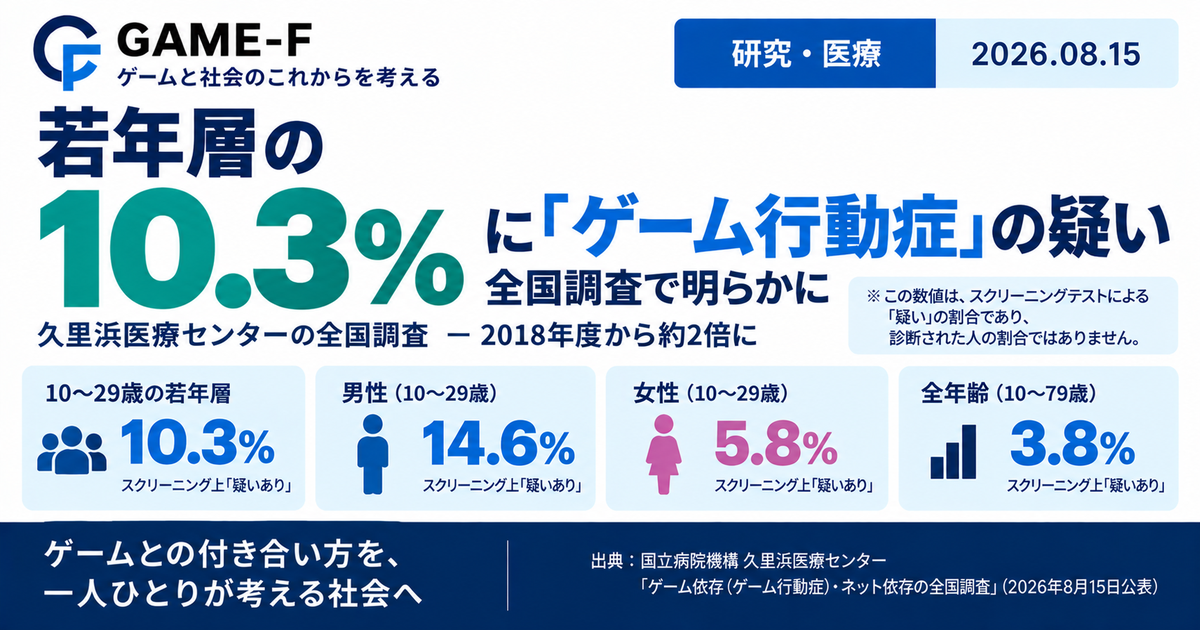
On August 15, 2026, findings from a nationwide survey conducted by the National Hospital Organization Kurihama Medical and Addiction Center were reported, showing that 10.3% of people aged 10–29 screened positive for possible gaming disorder. In a comparable survey conducted in fiscal 2018, the figure was 5.1%.
The survey was conducted as a government-supported national study. Questionnaires were sent to 9,000 randomly selected residents aged 10 to under 80 years, and 4,650 valid responses were obtained.
Using the GAMES Test, a score of five or higher was classified as indicating possible gaming disorder. The age-adjusted proportion was 3.8% overall, but 10.3% among those aged 10–29. Among younger respondents, the proportion was 14.6% in males and 5.8% in females.
Importantly, 10.3% does not represent the proportion clinically diagnosed with gaming disorder. The GAMES Test is a screening instrument, and a positive result indicates that gaming disorder may be suspected and further assessment may be appropriate.
Comment from GAME-F
The figure of 10.3% could easily be interpreted as meaning that approximately one in ten young people has gaming disorder. Screening positivity, however, is not equivalent to a clinical diagnosis.
At the same time, the findings suggest that a substantial number of young people may need greater attention to their relationship with gaming. Rather than viewing gaming itself as the problem, it is important to notice changes such as difficulty stopping, disrupted sleep, deterioration in school or work performance, or loss of interest in other important activities.
GAME-F similarly emphasizes early recognition of such changes so that children, families, and educators can respond before difficulties become more serious.
References
久里浜医療センター「GAMES Test」
厚生労働省「ゲーム依存(ゲーム行動症)・ネット依存の全国調査」
共同通信「ゲーム依存、若年層は10% 18年度比で増、生活支障も」2026年8月15日。https://kumanichi.com/articles/2025580?utm_source=chatgpt.com


Latest Fact Blog
-
Society & Policy2026.10.16Major Data Breaches Across Japan — Millions of Records Exposed and the Vulnerabilities of a Digital Society
-
Society & Policy2026.10.15“Keep Filming!” — Smartphones as Tools for Protecting Children's Rights During Student Protests in France
-
Research & Health2026.10.04Short-Form Video Addiction and Declining “Future Thinking” — A One-Year Study of 1,567 Chinese Adolescents