Fact Blog
UK Announces Plan to Ban Social Media Services for Children Under 16
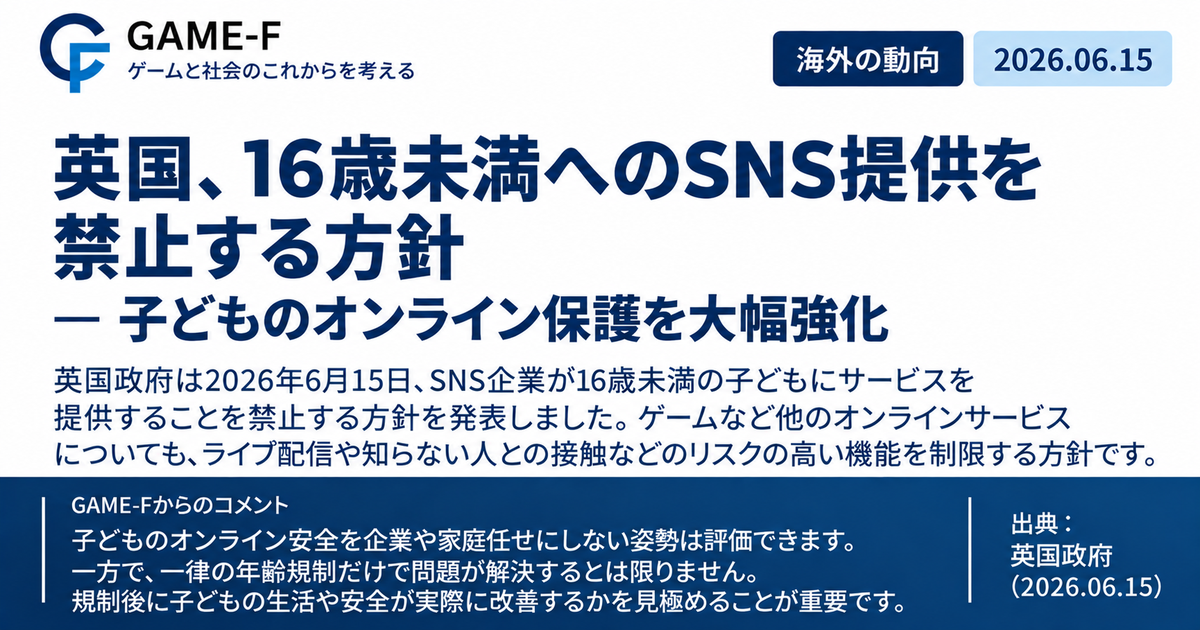
On June 15, 2026, the UK government announced plans to prohibit social media companies from offering their services to children under the age of 16. Platforms expected to fall within the scope include TikTok, Instagram, YouTube, Snapchat, Facebook and X, while messaging services such as WhatsApp and Signal are not intended to be included.
The announcement followed the national consultation Growing up in the online world, conducted between March and May 2026. More than 116,000 responses were received. Among parents who responded, 90% supported a minimum age of at least 16 for social media access. In contrast, only 19% of children supported setting 16 as the minimum age across all social media platforms, revealing a substantial difference between parental and children's perspectives.
The government also plans to restrict higher-risk functions—including livestreaming and communication with strangers—for children under 16 across other online services, including gaming services. Stronger age-assurance measures are also planned to support enforcement.
The first regulations are expected to be presented to Parliament by the end of 2026, with implementation planned for spring 2027. The June 15 announcement therefore represents a policy that is intended to be implemented, rather than a restriction already in force.
Comment from GAME-F
The UK's decision to draw a clear line at age 16 deserves recognition for making children's online safety a responsibility not only of families, but also of the companies providing these services.
Particularly important is the proposal to regulate higher-risk functions such as livestreaming and contact with strangers. GAME-F supports the principle that children should not be expected to manage every online risk themselves and that service providers also have a responsibility to create safer digital environments.
At the same time, a uniform rule prohibiting social media use below the age of 16 is unlikely to solve the problem by itself. Social media can also support friendships, access to information and creative activities, and there is no clear medical boundary separating safety at age 15 from safety at age 16. Policymakers must also consider possible unintended consequences, such as children misrepresenting their age or moving to services outside the scope of regulation.
The real measure of the UK's policy should therefore not be whether a ban was introduced, but whether children's lives and safety actually improve after the restrictions are implemented.
References
UK Government — Social media to be banned for under-16s, June 15, 2026
UK Government — Growing up in the online world: progress statement
UK Government — Fact sheet: New rules to protect children online


Latest Fact Blog
-
Society & Policy2026.10.16Major Data Breaches Across Japan — Millions of Records Exposed and the Vulnerabilities of a Digital Society
-
Society & Policy2026.10.15“Keep Filming!” — Smartphones as Tools for Protecting Children's Rights During Student Protests in France
-
Research & Health2026.10.04Short-Form Video Addiction and Declining “Future Thinking” — A One-Year Study of 1,567 Chinese Adolescents