Fact Blog
How Do Gaming Disorder Symptoms Change from Adolescence to Early Adulthood? An Eight-Year Longitudinal Study
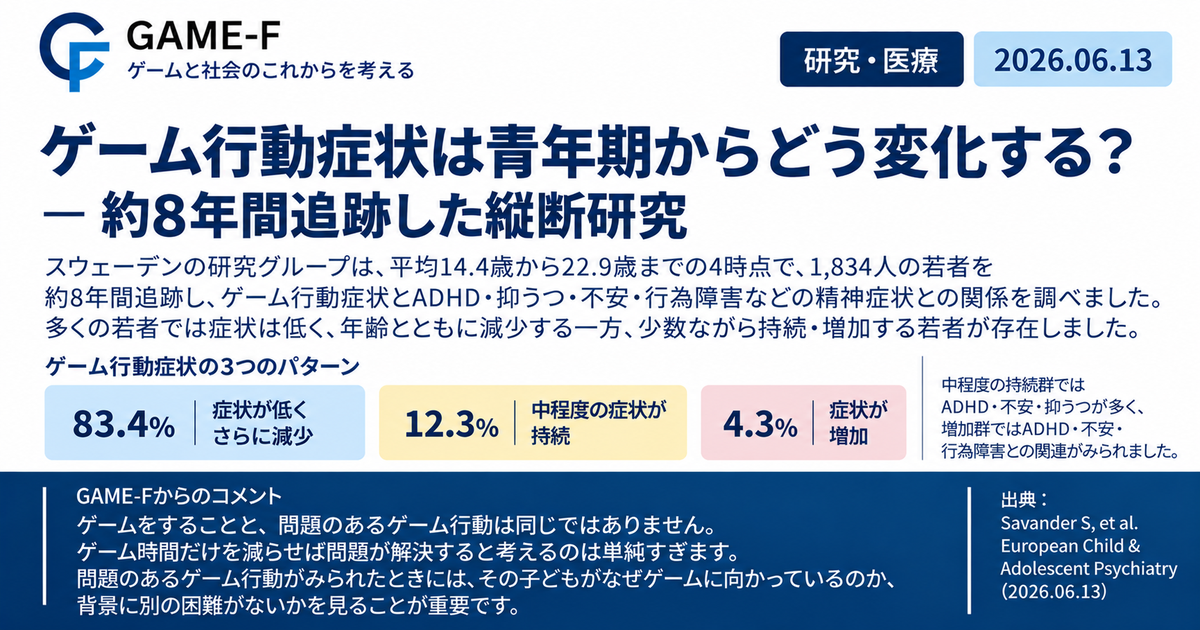
A Swedish research group published a longitudinal study in European Child & Adolescent Psychiatry on June 13, 2026, examining the development of Gaming Disorder (GD) symptoms and psychiatric symptoms from adolescence into early adulthood.
Participants were assessed at four time points, at mean ages of 14.4, 17.4, 20.2 and 22.9 years. Self-reported symptoms of GD, ADHD, depression, anxiety and conduct disorder were examined. The first wave included 1,834 participants, while 1,066 participated in the fourth wave.
Three main trajectories of GD symptoms were identified. 83.4% showed low and decreasing symptoms, 12.3% showed moderate and stable symptoms, and 4.3% showed increasing symptoms. Thus, GD symptoms remained low or decreased for most young people, while a smaller group showed persistent or increasing symptoms. The moderate-stable group showed higher levels of ADHD, anxiety and depressive symptoms, while the increasing-symptom group showed associations with ADHD, anxiety and conduct disorder symptoms. The authors concluded that GD and psychiatric symptoms followed parallel developmental patterns, suggesting a potentially reciprocal relationship.
Comment from GAME-F
An important feature of this study is that it does not treat “playing games” and “problematic gaming” as the same phenomenon. For most young people, GD symptoms were low and tended to decrease with age. However, a smaller group showed persistent or increasing symptoms, accompanied by complex associations with psychiatric symptoms including ADHD, anxiety and depression.
These findings do not demonstrate that gaming causes ADHD, anxiety or depression. Rather, we should be cautious about assuming that either gaming problems or psychiatric difficulties are simply the cause of the other.
It may therefore be overly simplistic to assume that reducing gaming time alone will solve the problem. When problematic gaming emerges, attention should be paid not only to stopping gaming, but also to why the young person is turning to gaming and whether other difficulties may be present in the background.
References
Savander S, et al. European Child & Adolescent Psychiatry, 2026 — Springer
PubMed — Gaming disorder symptoms and psychiatric comorbidity from adolescence to early adulthood


Latest Fact Blog
-
Society & Policy2026.10.16Major Data Breaches Across Japan — Millions of Records Exposed and the Vulnerabilities of a Digital Society
-
Society & Policy2026.10.15“Keep Filming!” — Smartphones as Tools for Protecting Children's Rights During Student Protests in France
-
Research & Health2026.10.04Short-Form Video Addiction and Declining “Future Thinking” — A One-Year Study of 1,567 Chinese Adolescents