Fact Blog
Can Problematic Gaming Improve as Adolescents Mature? A Five-Year Study Identifies Natural Recovery
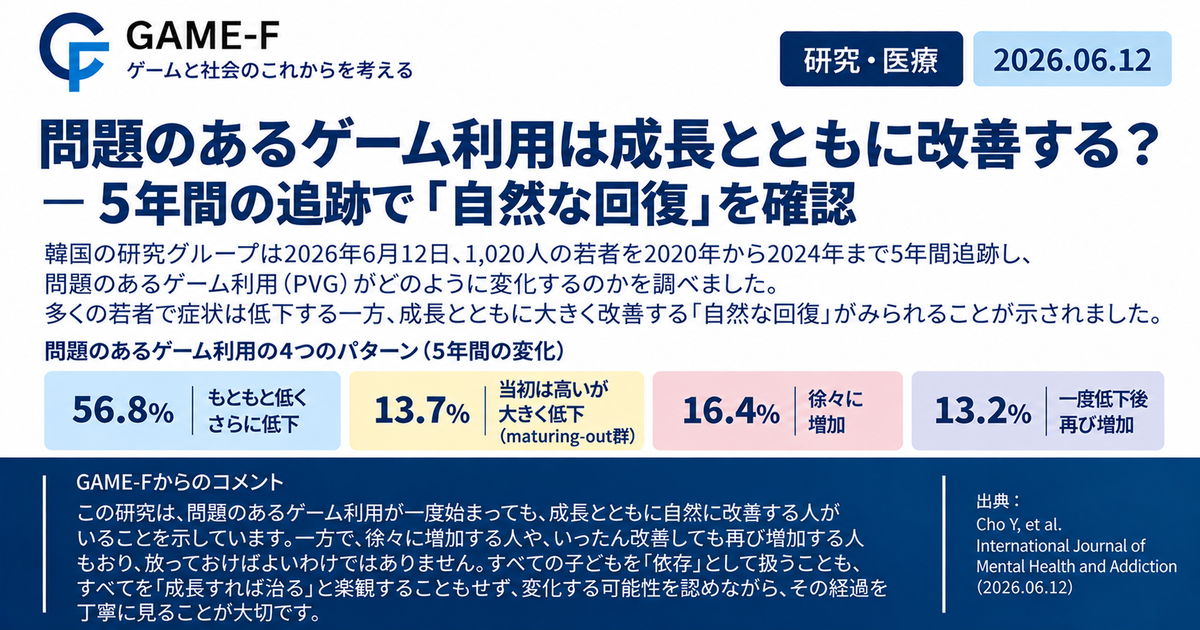
A five-year longitudinal study of young people in South Korea was published in the International Journal of Mental Health and Addiction on June 12, 2026. The study examined how problematic video gaming (PVG) changes across development.
The study included 1,020 participants at baseline and used five annual waves of data collected from 2020 to 2024. PVG was assessed across seven dimensions, including tolerance, withdrawal, excessive time investment, impaired control, compulsive use, neglect of daily life, and continued gaming despite negative consequences.
Four distinct developmental trajectories were identified: a steadily increasing group (16.4%), a “maturing-out” group with high initial PVG followed by a marked decline (13.7%), a gradually decreasing group (56.8%), and a rebounding group that initially improved but later increased again (13.2%).
The maturing-out group was particularly notable. Despite having the highest initial level of problematic gaming, symptoms subsequently declined substantially. Professional interventions such as counseling or hospital visits were rare, suggesting that problematic gaming may sometimes improve naturally as young people mature and their social roles and circumstances change. Transition into adulthood was also strongly associated with recovery-oriented trajectories.
Comment from GAME-F
This study suggests that problematic gaming does not necessarily become chronic once it develops. One particularly interesting finding is that some young people with initially high levels of problematic gaming improved despite receiving little formal professional intervention. Changes associated with growing up—including education, employment, relationships and new responsibilities—may themselves alter the role that gaming plays in a person's life.
However, the finding that natural recovery can occur should not be interpreted as evidence that problematic gaming can simply be ignored. Some participants showed steadily increasing problems, while others initially improved and later rebounded. It may not be easy to predict at an early stage who will recover and who will deteriorate. The appropriate response is neither to label every young person as “addicted” nor to assume that everyone will simply grow out of it. We need to recognize that gaming behavior can change while carefully observing its trajectory over time.
References


Latest Fact Blog
-
Society & Policy2026.10.16Major Data Breaches Across Japan — Millions of Records Exposed and the Vulnerabilities of a Digital Society
-
Society & Policy2026.10.15“Keep Filming!” — Smartphones as Tools for Protecting Children's Rights During Student Protests in France
-
Research & Health2026.10.04Short-Form Video Addiction and Declining “Future Thinking” — A One-Year Study of 1,567 Chinese Adolescents