Fact Blog
US Jury Holds Meta and Google Liable Over Social Media Design in Landmark Verdict
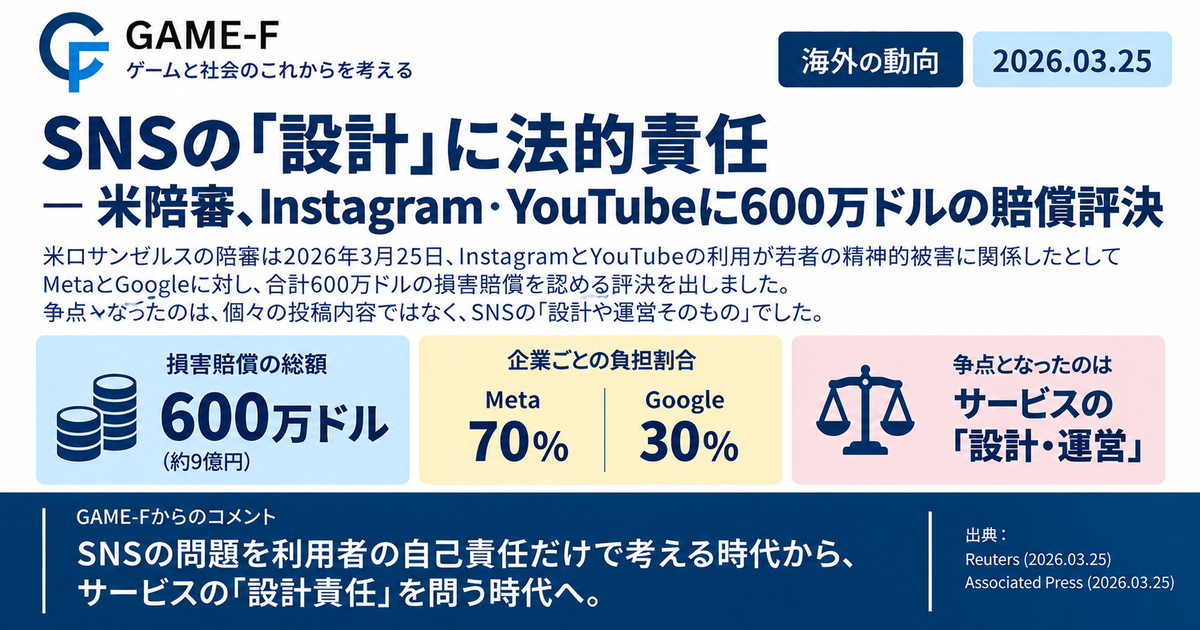
On March 25, 2026, a Los Angeles jury returned a verdict against Meta and Google in a case alleging that the use of Instagram and YouTube contributed to psychological harm suffered by a young plaintiff. The jury awarded $6 million in total damages, assigning 70% of the responsibility to Meta and 30% to Google.
A notable feature of the case was its focus not simply on individual pieces of content appearing on social media, but on the design and operation of the platforms themselves. The jury found negligence and concluded that the companies' conduct was a “substantial factor” in the plaintiff's harm.
The award consisted of $3 million in compensatory damages and $3 million in punitive damages, with $1.5 million in punitive damages assessed against each company. TikTok and Snap, which had also been defendants in the litigation, reached settlements before trial.
Importantly, the verdict does not constitute medical proof that social media causes psychiatric disorders or addiction. It represents a civil jury's determination of liability in an individual case. Meta and Google disputed the verdict.
Comment from GAME-F
The most significant aspect of this verdict is that the focus was not simply on whether an individual “used social media too much,” but on the design of the services themselves.
Efforts to protect children online have often emphasized user-side measures: limiting screen time, parental supervision and individual self-control. However, if platforms incorporate features designed to keep users engaged for longer periods, there are limits to placing responsibility for self-regulation on children alone. In this respect, the jury's decision to recognize responsibility on the part of service providers is significant.
At the same time, the verdict should not be interpreted as medical proof that Instagram or YouTube causes depression or addiction. A legal determination of responsibility in an individual case should be distinguished from scientific evidence establishing causality at the population level.
Nevertheless, the fact that attention is shifting from simply asking whether content is harmful to examining how services are designed to keep people engaged is important. This verdict symbolizes a broader shift in the debate over children's digital lives—from individual responsibility toward platform design responsibility.
References
Reuters — What did the jury decide in social media case against Meta, Google? March 25, 2026
Associated Press — Jury finds Meta and YouTube liable in landmark social media addiction trial


Latest Fact Blog
-
Society & Policy2026.10.16Major Data Breaches Across Japan — Millions of Records Exposed and the Vulnerabilities of a Digital Society
-
Society & Policy2026.10.15“Keep Filming!” — Smartphones as Tools for Protecting Children's Rights During Student Protests in France
-
Research & Health2026.10.04Short-Form Video Addiction and Declining “Future Thinking” — A One-Year Study of 1,567 Chinese Adolescents