Fact Blog
OpenAI Strengthens AI Safety Measures for Teens in Japan, Emphasizing Age Prediction, Parental Controls and Well-Being
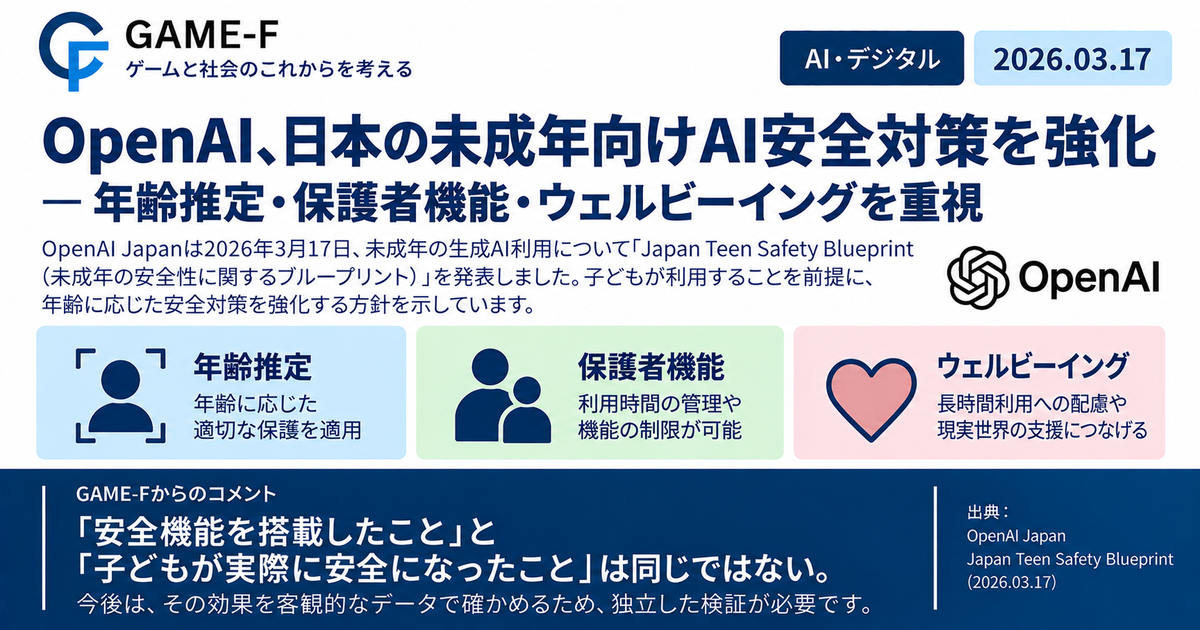
On March 17, 2026, OpenAI Japan released the Japan Teen Safety Blueprint, outlining its approach to protecting young people using generative AI in Japan.
The blueprint is based on the premise that teenagers will use generative AI and that appropriate safeguards should therefore be built around their use. Key elements include age prediction, additional protections for users under 18, parental controls, and product design focused on well-being.
Where a user's age is uncertain, age-prediction technology can be used to help determine whether protections intended for users under 18 should apply. Parental controls are also intended to give parents and guardians greater ability to manage aspects of their teenager's use, including when and how certain features are available.
The blueprint also addresses broader questions of well-being, including prolonged interactions with AI and mechanisms intended to connect users with real-world support when serious risks arise. The approach therefore focuses not simply on whether young people can use AI, but on how AI can be used more safely.
Comment from GAME-F
GAME-F supports moving beyond a simple choice between “banning AI for children” and “allowing unrestricted use,” toward designing AI systems with the expectation that young people will use them.
Age-appropriate protections, parental controls, attention to prolonged use, and mechanisms that connect young people with real-world support are important as generative AI becomes increasingly integrated into everyday life.
However, it is not sufficient for the companies providing safety measures to be the only ones evaluating whether those measures are effective. Independent research is also needed to determine how accurately age prediction works in practice, how parental controls are actually used, and how prolonged interactions with AI may affect young people's psychological well-being and relationships.
Introducing a safety feature is not the same as demonstrating that children are safer. The next step should be to evaluate these measures objectively using real-world evidence.
References
OpenAI Japan — Japan Teen Safety Blueprint, March 17, 2026
OpenAI — Japan Teen Safety Blueprint, English version


Latest Fact Blog
-
Society & Policy2026.10.16Major Data Breaches Across Japan — Millions of Records Exposed and the Vulnerabilities of a Digital Society
-
Society & Policy2026.10.15“Keep Filming!” — Smartphones as Tools for Protecting Children's Rights During Student Protests in France
-
Research & Health2026.10.04Short-Form Video Addiction and Declining “Future Thinking” — A One-Year Study of 1,567 Chinese Adolescents