Fact Blog
U Proposes “KIDS Act” to Regulate Children’s Access to Social Media, Gaming and AI
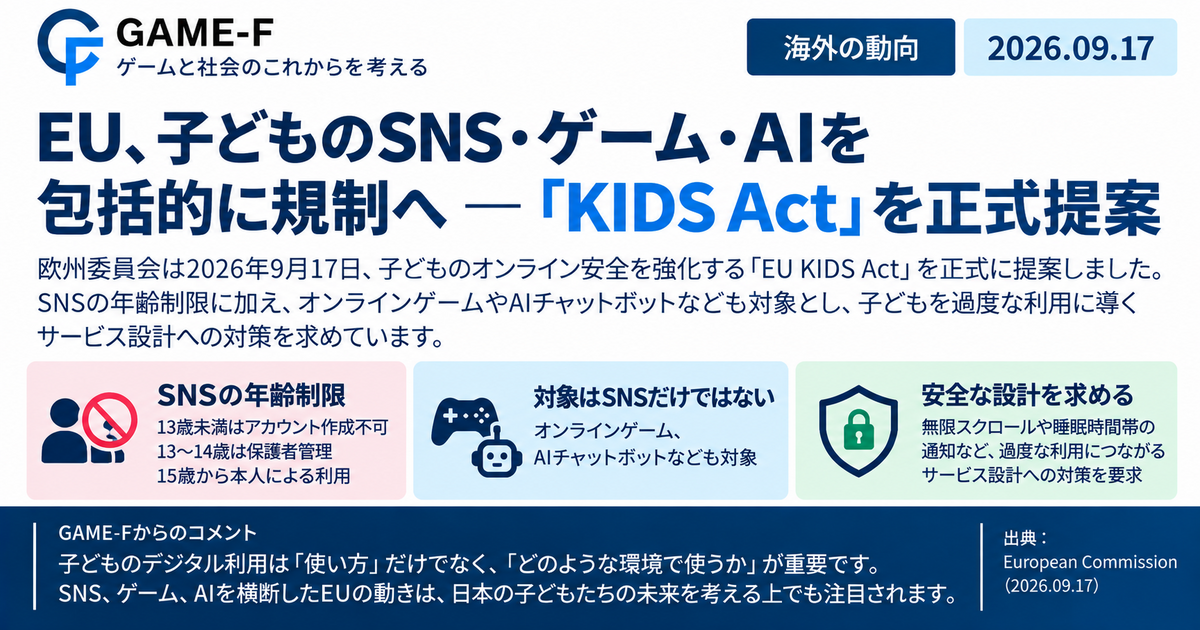
On 17 September 2026, the European Commission formally proposed the “EU KIDS Act,” a new framework aimed at strengthening the protection of children online. The proposal introduces age-based rules for social media accounts, including restrictions for children under 13 and parental supervision for younger teenagers.
Importantly, the proposal extends beyond social media to areas including online gaming and AI chatbots. It also addresses design features that may encourage excessive use, such as infinite scrolling and notifications during sleeping hours.
The proposal has not yet become law. It will be considered by the European Parliament and the Council of the European Union, and its provisions may change during the legislative process.
Comment from GAME-F
The EU is moving beyond placing responsibility for children’s online safety solely on children and their families. In addition to age-based restrictions, it is seeking to require social media, gaming, and AI services to provide safer digital environments by design. Japan is also reviewing its framework for protecting young people online.
Although regulatory approaches differ between countries, the key question is no longer simply “how many hours should children be allowed online?” We also need to consider the digital environments in which children spend their time and how these environments relate to sleep, learning, and family life. Protecting children in the digital age will require shared responsibility among users, families, service providers, and society.
References


Latest Fact Blog
-
Society & Policy2026.10.16Major Data Breaches Across Japan — Millions of Records Exposed and the Vulnerabilities of a Digital Society
-
Society & Policy2026.10.15“Keep Filming!” — Smartphones as Tools for Protecting Children's Rights During Student Protests in France
-
Research & Health2026.10.04Short-Form Video Addiction and Declining “Future Thinking” — A One-Year Study of 1,567 Chinese Adolescents