Fact Blog
“Voice” as a Right in the AI Era: Voice Actors Explore Responsible Use of AI
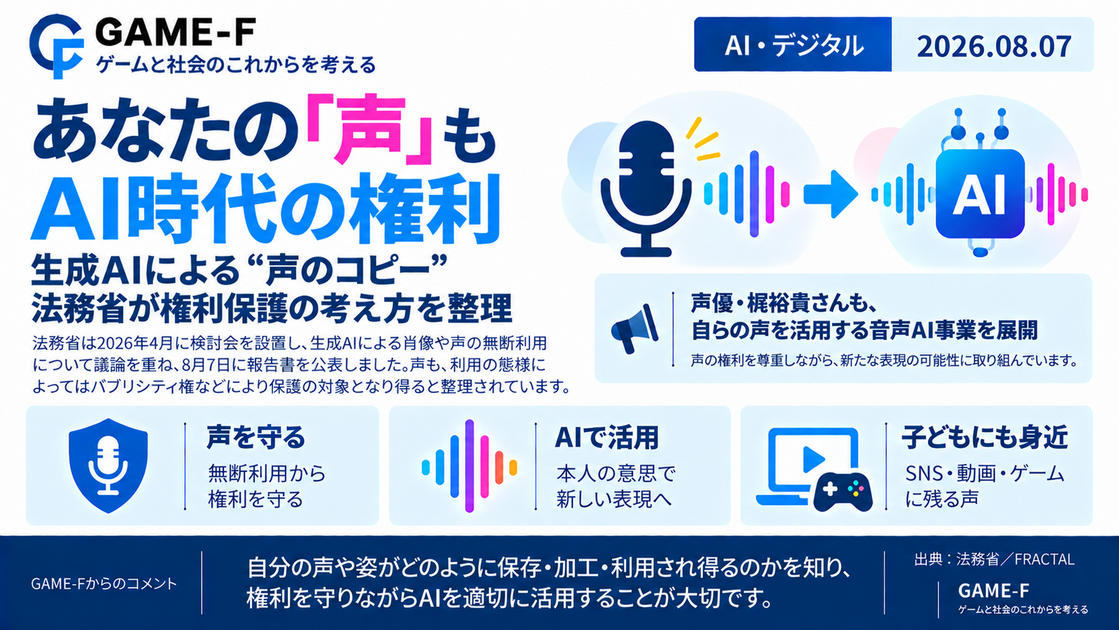
Generative AI has made it increasingly easy to reproduce voices and images that closely resemble real people. In 2026, Japan’s Ministry of Justice examined the unauthorized use of a person’s image and voice, clarifying how existing civil-law protections may apply to AI-generated content.
At the same time, Japanese voice actor Yuki Kaji is taking a proactive approach. His “Soyogi Fractal” project is built around “Soyogi Soyogi,” voice-synthesis technology based on his own voice. In April 2026, Kaji established FRACTAL Inc., which promotes AI-based creative activities while emphasizing respect for performers’ rights and intentions. In July, FRACTAL also partnered with Yoyogi Animation Academy to develop an educational program addressing expression and performers’ rights in the AI era.
Comment from GAME-F
AI voice cloning is not an issue limited to celebrities or professional performers. Through social media, online videos, and games, children increasingly leave not only their images but also their voices in digital spaces.
The goal should not simply be to keep children away from AI. They need to understand how their voices and images may be stored, modified, and reused, and how to protect their rights while using AI appropriately. In the AI era, a person’s voice should also be understood as an important part of their digital identity.
References
Ministry of Justice — Study Group on Unauthorized Use of Images and Voices
FRACTAL — Voice AI Business
Yoyogi Animation Academy — Education on Voice Acting, AI and Rights


Latest Fact Blog
-
Society & Policy2026.10.16Major Data Breaches Across Japan — Millions of Records Exposed and the Vulnerabilities of a Digital Society
-
Society & Policy2026.10.15“Keep Filming!” — Smartphones as Tools for Protecting Children's Rights During Student Protests in France
-
Research & Health2026.10.04Short-Form Video Addiction and Declining “Future Thinking” — A One-Year Study of 1,567 Chinese Adolescents