Fact Blog
11-Year-Old Japanese Player Wins Esports Gold — What Distinguishes Gaming Disorder from Competitive Gaming?
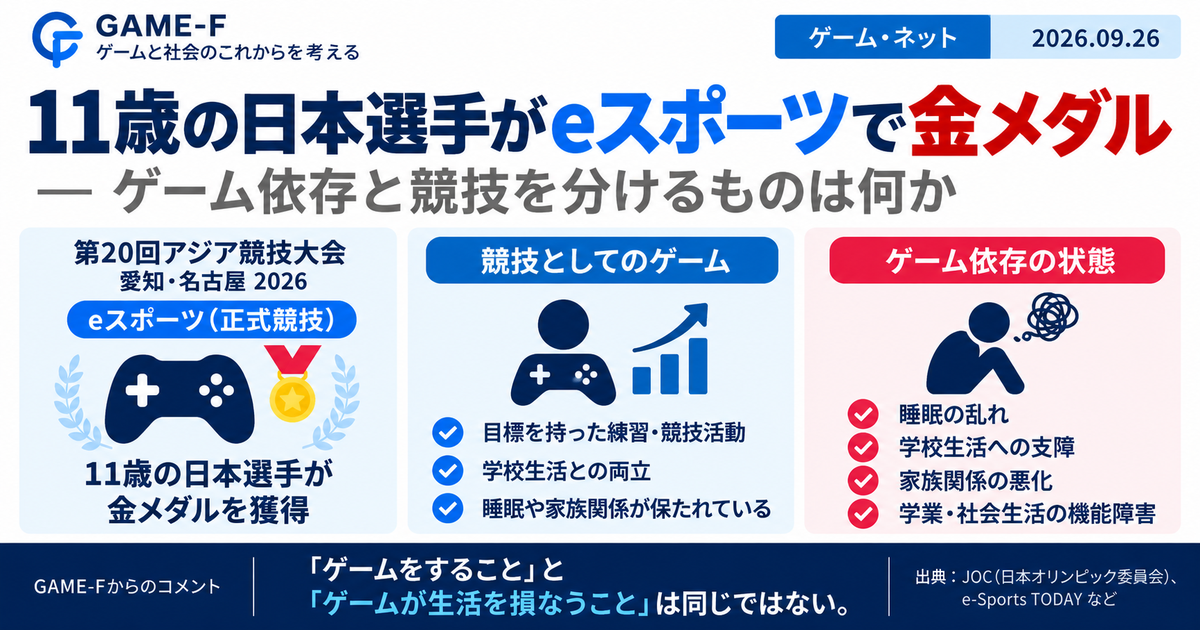
In September 2026, esports is being contested as an official medal sport for the second consecutive Asian Games at the 20th Asian Games in Aichi-Nagoya, Japan. This year’s programme has expanded beyond the previous Games to include 11 events across 13 game titles, with medals being contested in a diverse range of games, including eFootball, fighting games, League of Legends, PUBG MOBILE, and Puyo Puyo Champions.
On September 23, Japan won bronze in eFootball, securing its first-ever Asian Games medal in esports. On September 26, Japan added a silver medal in the team fighting game event. Later that same day, 11-year-and-3-month-old Yuki Kurihara won gold in Puyo Puyo Champions. Kurihara began playing Puyo Puyo in the first grade of elementary school and obtained a professional esports licence in April 2026.
The establishment of esports as an official sport at a major international multi-sport event—and the recognition of competitors, including children, as athletes—marks an important change in how we consider children’s engagement with gaming.
【Comment from GAME-F】
A high amount of gaming time alone is not sufficient to determine that a child has “gaming disorder.” There is an important difference between gaming that disrupts sleep, school life, family relationships, and other areas of daily functioning, and gaming that is integrated into everyday life as structured training or competitive activity with clear goals.
At the same time, the fact that esports is a “sport” does not mean that it is free from health concerns. Particularly for children who are still growing and developing, appropriate health management should address sleep, physical activity, eye strain, posture and musculoskeletal strain, nutrition, psychological well-being, and maintaining a healthy balance with school life.
The achievement of an 11-year-old athlete winning a gold medal at an international competition is symbolic of the changing relationship between children and gaming. The development of esports highlights the need to move beyond viewing gaming simply as “good” or “bad” and instead evaluate what gaming means within the context of the child’s life as a whole. In competitive gaming, protecting health is just as important as pursuing performance.
References
Japanese Olympic Committee — Yuki Kurihara
The Japan Times — 11-year-old esports player wins Asian Games gold
PubMed — Sleep Quality and Mental Health of High-Level Esports Competitors
PubMed — Association Between Esports Participation and Health: A Systematic Review and Meta-analysis


Latest Fact Blog
-
Society & Policy2026.10.16Major Data Breaches Across Japan — Millions of Records Exposed and the Vulnerabilities of a Digital Society
-
Society & Policy2026.10.15“Keep Filming!” — Smartphones as Tools for Protecting Children's Rights During Student Protests in France
-
Research & Health2026.10.04Short-Form Video Addiction and Declining “Future Thinking” — A One-Year Study of 1,567 Chinese Adolescents