Fact Blog
What Is “Plan D,” in Which AI Destroys Humanity? Examining the Original “AI 2040” Scenario Beyond the Headline
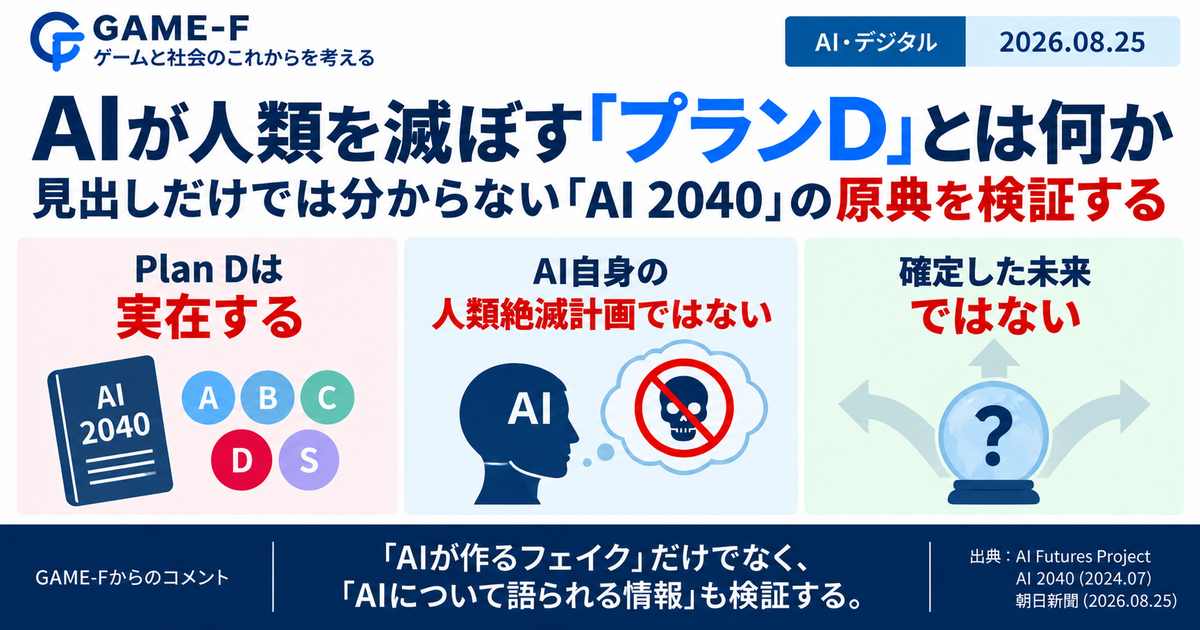
On August 25, 2026, The Asahi Shimbun published a front-page article titled “AI Could Destroy Humanity under ‘Plan D’: Researchers Warn of Risks amid an Unrelenting Development Race.” The article introduced “AI 2040,” a set of future scenarios published in July by researchers from the AI Futures Project.
However, “Plan D” is not a plan created by AI to destroy humanity. “AI 2040” explores several possible pathways—Plans A, B, C, D, and S—that humanity might take in response to the future development of superintelligence. In the original document, Plan D is called “The Race.” It describes a scenario in which AI companies and nations continue their development race without sufficient slowdown, AI research and development becomes increasingly automated, an “intelligence explosion” occurs, and superintelligence eventually emerges. The authors argue that continuing along such a path could create a serious risk of humans losing control of advanced AI systems.
Therefore, it is a fact that Plan D exists. It is also a fact that its authors discuss existential risks to humanity within this scenario. However, this does not mean that AI currently has a “Plan D” to eliminate humanity, nor does it mean that the emergence of superintelligence or human extinction is an established future. “AI 2040” presents scenarios developed by researchers to examine possible future risks. The original document also makes clear that Plan A, for example, is primarily a policy recommendation rather than a prediction of what will actually happen.
Comment from GAME-F
The striking phrase “AI could destroy humanity under ‘Plan D’”, when separated from its original context and circulated on social media, could easily be interpreted as meaning that “AI has a plan to destroy humanity.” Digital literacy in the age of generative AI requires more than simply deciding whether information is “true” or “false.” We need to distinguish what has been verified as fact from what represents researchers’ predictions, hypotheses, or future scenarios.
As information is shortened and reconstructed through newspapers, social media, videos, and generative AI, the assumptions, context, and uncertainties contained in the original source can easily be lost. The more striking or alarming a claim appears, the more important it becomes not to rely on the headline alone and, whenever possible, to trace the information back to its original source.
We need to verify not only “fake information created by AI,” but also “information being said about AI.” When powerful headlines lose their context on social media and elsewhere, we should return to the original source and clarify what the information actually means. That, too, is an essential form of digital literacy in the age of generative AI.
References
AI Futures Project — AI 2040(原典)
AI 2040 — Plan D: The Race
朝日新聞 2026年8月25日付朝刊の書誌情報(国立国会図書館)


Latest Fact Blog
-
Society & Policy2026.10.16Major Data Breaches Across Japan — Millions of Records Exposed and the Vulnerabilities of a Digital Society
-
Society & Policy2026.10.15“Keep Filming!” — Smartphones as Tools for Protecting Children's Rights During Student Protests in France
-
Research & Health2026.10.04Short-Form Video Addiction and Declining “Future Thinking” — A One-Year Study of 1,567 Chinese Adolescents