Fact Blog
Australia Examines Child Safety Measures Across Major Online Gaming Services
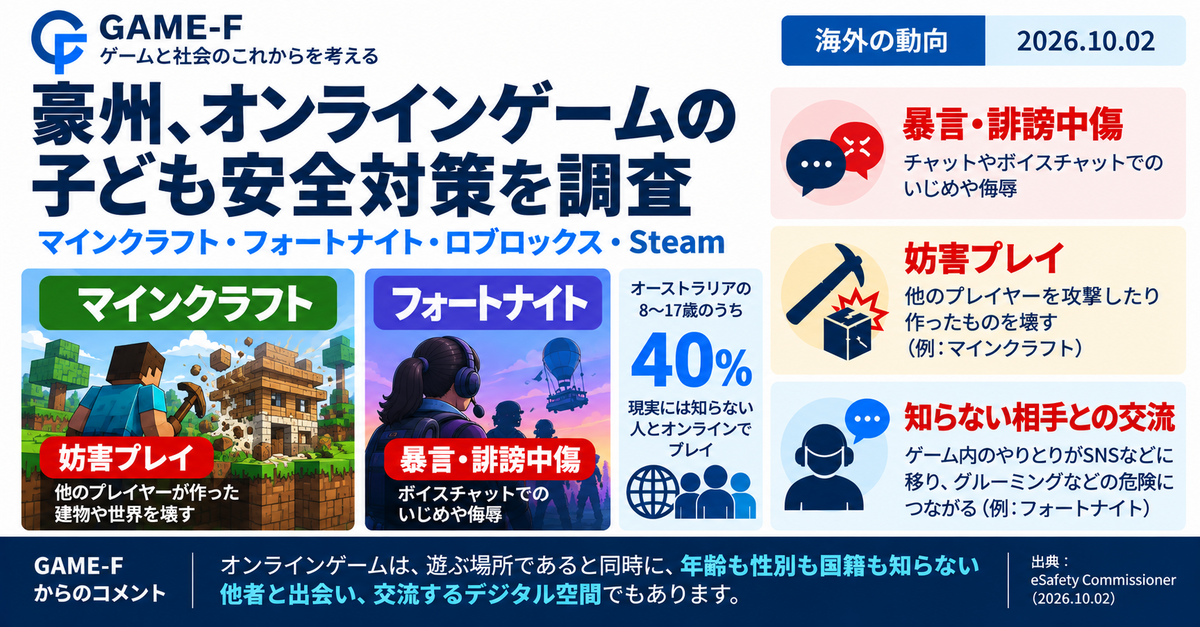
On October 2, 2026, Australia's eSafety Commissioner released a transparency report examining child safety measures across Minecraft, Fortnite, Roblox, and Steam.
The investigation examined how these services identify, prevent, and respond to serious online harms, including child sexual exploitation and grooming, sexual extortion, violent and extremist material and activity, cyberbullying, and online hate. The report found significant differences in safety measures across the services and identified continuing gaps in the prevention, detection, and response to serious online harms.
Differences were identified in areas including age assurance, systems for detecting harmful activity in communications, measures against offending users, and information sharing between service providers.
Previous eSafety research found that 89% of Australian children aged 8–17 had played online games during the previous year, 79% had played multiplayer online games with others, and 40% had played online with people they did not know offline.
Comment from GAME-F
Today's online games are not only places to play. They are also digital spaces where children can meet and interact with people whose age, gender, and nationality they may not know.
Online gaming can involve verbal abuse, harassment, exclusion, repeated targeting of particular players, interference with gameplay, and intentional destruction of things created by other players—behaviours sometimes described as “griefing.” Communication through in-game text or voice chat can also move to social media or private messaging services, potentially exposing children to more serious risks such as grooming and sexual exploitation.
For example, in Minecraft, something a child has spent days building may be intentionally destroyed by another player. In Fortnite, children may be teamed with players they do not know and may encounter verbal abuse, insults, or bullying through voice chat. Although these events occur within a game, they can still be distressing experiences for children and may affect them in ways similar to conflicts in offline relationships.
Online games are easily accessible entertainment that children can enjoy from home, but the person on the other side of the screen may be someone they know nothing about. Parents and other adults should therefore pay attention not only to how long children play, but also to who they interact with and how those interactions take place.
References
eSafety Commissioner
Gaming giants urged to level-up child safety measures
Responses to transparency notices: Online game and gaming-adjacent services


Latest Fact Blog
-
Society & Policy2026.10.16Major Data Breaches Across Japan — Millions of Records Exposed and the Vulnerabilities of a Digital Society
-
Society & Policy2026.10.15“Keep Filming!” — Smartphones as Tools for Protecting Children's Rights During Student Protests in France
-
Research & Health2026.10.04Short-Form Video Addiction and Declining “Future Thinking” — A One-Year Study of 1,567 Chinese Adolescents