Fact Blog
Japan Passes New Law to Combat Election Misinformation on Social Media
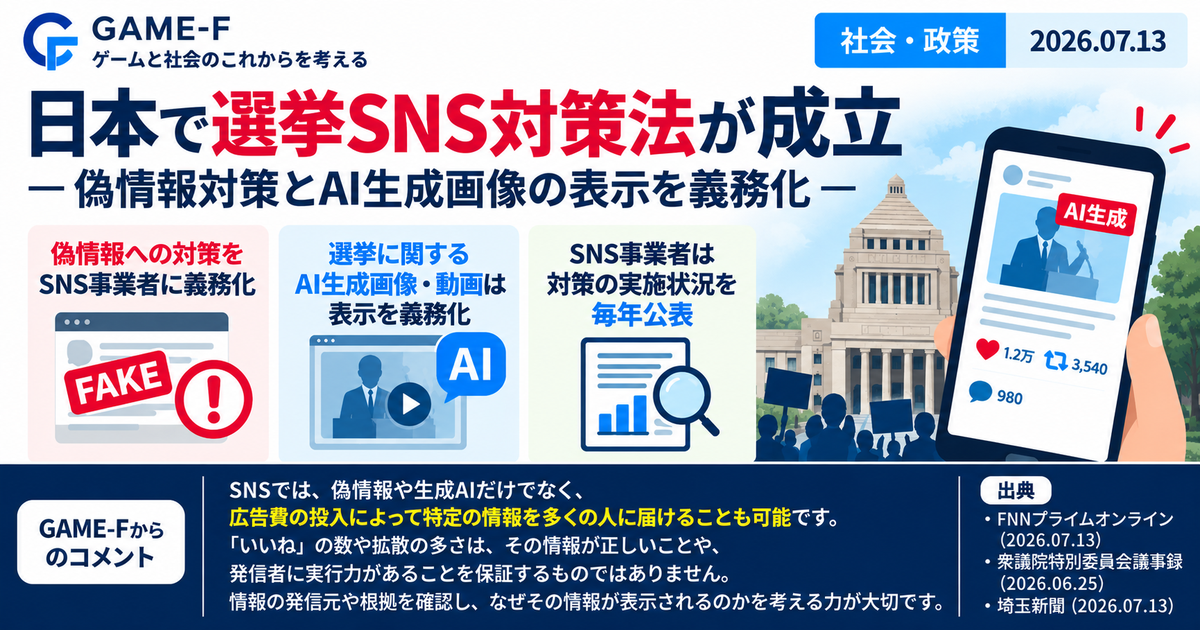
On July 13, 2026, Japan passed legislation to strengthen measures against misinformation and other harmful information circulating on social media during elections.
The amended law requires major social media platforms to take measures to reduce the negative effects of information that could undermine fair elections. It also generally requires disclosure when images or videos related to elections have been created or altered using generative AI and posted online.
Major platforms must publish information about their measures annually. However, the law does not require the automatic removal of individual posts. Balancing effective measures against misinformation with freedom of expression remains an important challenge.
The law is scheduled to take effect on March 1, 2027.
Comment from GAME-F
Social media can spread misinformation and AI-generated images or videos, while paid advertising can also increase the visibility of particular messages. However, repeated exposure or a large number of “likes” does not guarantee that the information is accurate or that the person sharing it can deliver on their promises.
This legal reform provides an opportunity to reconsider the information environment surrounding elections. Children and young people also need to learn how to check sources and evidence, and to ask why certain information appears in their social media feeds.
References
House of Representatives, Japan — Special Committee on Political Reform, June 25, 2026
FNN Prime Online — Election-Related Social Media Regulation Law Enacted, July 13, 2026 (Japanese)
Saitama Shimbun — Election Social Media Measures Law Enacted, July 13, 2026 (Japanese)


Latest Fact Blog
-
Society & Policy2026.10.16Major Data Breaches Across Japan — Millions of Records Exposed and the Vulnerabilities of a Digital Society
-
Society & Policy2026.10.15“Keep Filming!” — Smartphones as Tools for Protecting Children's Rights During Student Protests in France
-
Research & Health2026.10.04Short-Form Video Addiction and Declining “Future Thinking” — A One-Year Study of 1,567 Chinese Adolescents