Fact Blog
Major Data Breaches Across Japan — Millions of Records Exposed and the Vulnerabilities of a Digital Society
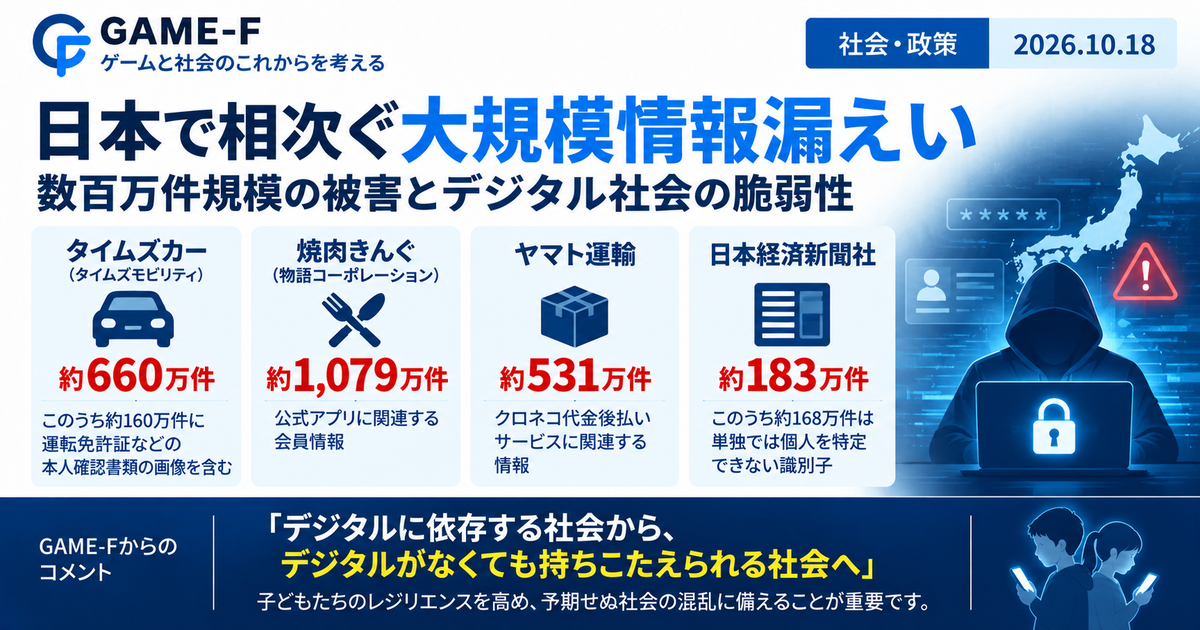
Between September and October 2026, several major Japanese companies reported large-scale personal data breaches resulting from unauthorized access.
On September 28, Times Mobility, the operator of the Times CAR car-sharing service, announced a data breach involving approximately 6.6 million account records. About 1.6 million of these records included images of identity verification documents, such as driver's licenses.
On October 5, Monogatari Corporation, the operator of the Yakiniku King restaurant chain, reported a breach involving approximately 10.79 million membership records associated with its official mobile application.
On October 16, Yamato Transport announced a data breach involving approximately 5.31 million records related to its Kuroneko deferred payment service. On the same day, Nikkei Inc. reported the exposure of approximately 1.83 million records stored in a cloud service used for system development. Of these, approximately 1.68 million were identifiers that could not independently identify individuals.
These figures do not necessarily represent the number of individuals affected. The types of information exposed and the extent of the incidents also differed among the companies.
On October 7, Tokyo Shoko Research reported that large-scale personal data breaches among listed Japanese companies were occurring at a record pace in 2026. In addition to data breaches, system disruptions caused by ransomware and other cyberattacks have become a significant social concern. In today's interconnected digital society, where healthcare, logistics, finance, and telecommunications depend heavily on digital technology, cyberattacks and communication failures can affect not only business operations but also everyday life.
Comment from GAME-F
The recent large-scale data breaches highlight how much of our personal information is entrusted to digital services. At the same time, system failures caused by cyberattacks, as well as power outages and communication disruptions resulting from natural disasters, can threaten everyday life in a society increasingly dependent on digital technology. We need to move from a society dependent on digital technology toward one that can remain resilient even when digital systems are unavailable.
What would happen if children suddenly could no longer use their smartphones, online games, or school tablets? Contacting family members, making purchases, finding directions, and playing with friends are all activities that may involve digital technology. When digital devices become unavailable, children need the ability to find alternative solutions, ask others for help, and adapt to unexpected situations.
Children need both the ability to use digital technology effectively and the ability to manage everyday life when it is unavailable. Developing both skills can strengthen children's resilience and help them prepare for unexpected disruptions in society.
References
Times CAR: Follow-up Report on the Exposure of Identity Verification Documents (September 29, 2026)


Latest Fact Blog
-
Society & Policy2026.10.15“Keep Filming!” — Smartphones as Tools for Protecting Children's Rights During Student Protests in France
-
Research & Health2026.10.04Short-Form Video Addiction and Declining “Future Thinking” — A One-Year Study of 1,567 Chinese Adolescents
-
Global Trends2026.10.02Australia Examines Child Safety Measures Across Major Online Gaming Services