Fact Blog
From AI to SI? — President Trump Orders a Change in the Terminology for Artificial Intelligence
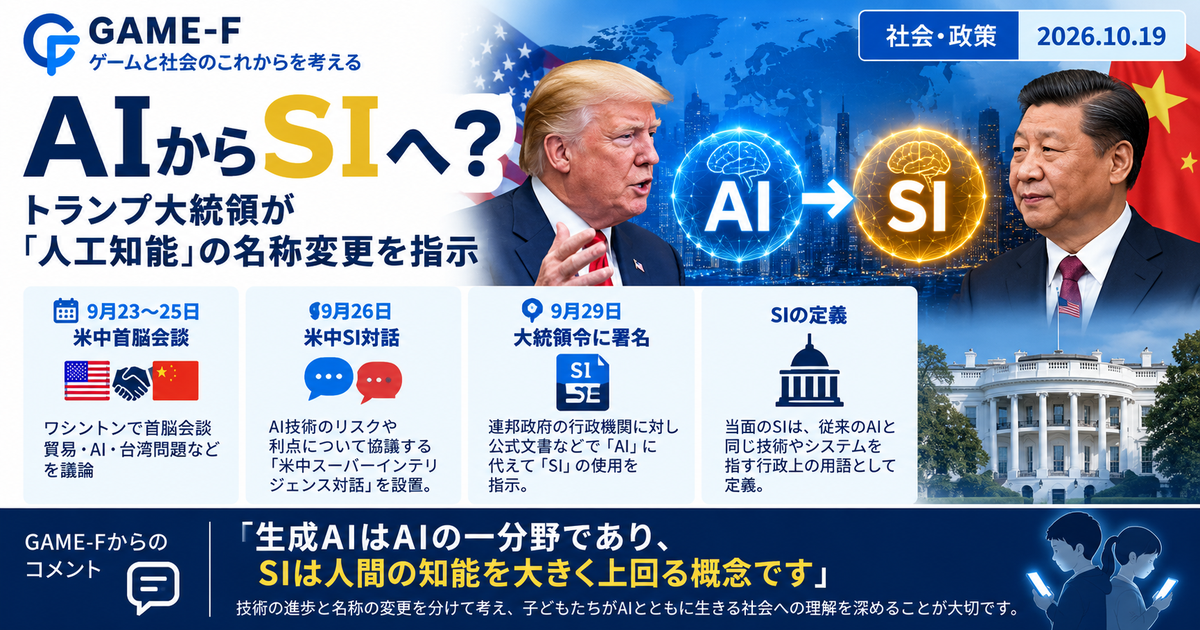
In September 2026, U.S. President Donald Trump expressed his preference for calling artificial intelligence (AI) "Super Intelligence" (SI) in connection with his summit with Chinese President Xi Jinping.
President Trump argued that the term "Artificial" did not adequately reflect the capabilities of today's advanced technology and proposed using "SI" instead of "AI."
On September 26, it was reported that the United States and China had agreed to establish a "U.S.-China Super Intelligence Dialogue" to discuss the risks and benefits of AI technology.
On September 29, President Trump signed Executive Order 14434, titled "Inaugurating the Era of Super Intelligence." The order directs U.S. federal executive agencies to use "Super Intelligence" (SI) instead of "Artificial Intelligence" (AI) in official correspondence, public communications, websites, reports, and other non-statutory documents.
However, for the purposes of this executive order, SI is currently defined as referring to the same technologies and systems covered by the existing federal definition of AI.
Comment from GAME-F
The theoretical foundations of artificial intelligence can be traced back to Alan Turing's work on computation in the 1930s and the mathematical model of artificial neurons proposed in 1943. In 1956, the term "Artificial Intelligence" became established through the Dartmouth conference in the United States, marking the emergence of AI as a distinct field of research.
Following advances in deep learning, generative AI systems such as ChatGPT began spreading rapidly throughout society from 2022 onward. AI systems capable of generating text, images, and audio are now used in education, healthcare, workplaces, and everyday life.
However, AI has not simply evolved into generative AI and then into SI. AI is a broad term covering technologies designed to perform tasks associated with intelligence, while generative AI is one category within this field. In academic discussions, SI, or superintelligence, refers to a hypothetical level of intelligence that greatly exceeds human intellectual capabilities across a wide range of domains.
President Trump's decision to change the terminology does not mean that AI has reached the level of superintelligence. Advances in technological capabilities and changes in the terminology used to describe those technologies should be considered separately.
Children will grow up in a society where AI is increasingly part of everyday life. Although AI can support learning and creativity, it can also generate incorrect information and cannot replace human judgment in every situation. As technology becomes more advanced, children will increasingly need the ability to think independently, verify information, and make their own judgments rather than simply accepting AI-generated answers.
References
The White House. Inaugurating the Era of Super Intelligence. Executive Order 14434, September 29, 2026.
The White House. Fact Sheet: President Donald J. Trump Inaugurates the Era of Super Intelligence. September 29, 2026.
Axios. U.S. and China Agree to "Super Intelligence" Dialogue Amid AI Tensions. September 26, 2026.
Dartmouth College. The Founding and Future of AI.
IBM. The History of Artificial Intelligence.


Latest Fact Blog
-
Society & Policy2026.10.16Major Data Breaches Across Japan — Millions of Records Exposed and the Vulnerabilities of a Digital Society
-
Society & Policy2026.10.15“Keep Filming!” — Smartphones as Tools for Protecting Children's Rights During Student Protests in France
-
Research & Health2026.10.04Short-Form Video Addiction and Declining “Future Thinking” — A One-Year Study of 1,567 Chinese Adolescents