Fact Blog
Nintendo's Revenue Falls 12% While Operating Profit Rises 49% — What Drives Profitability in the Gaming Industry?
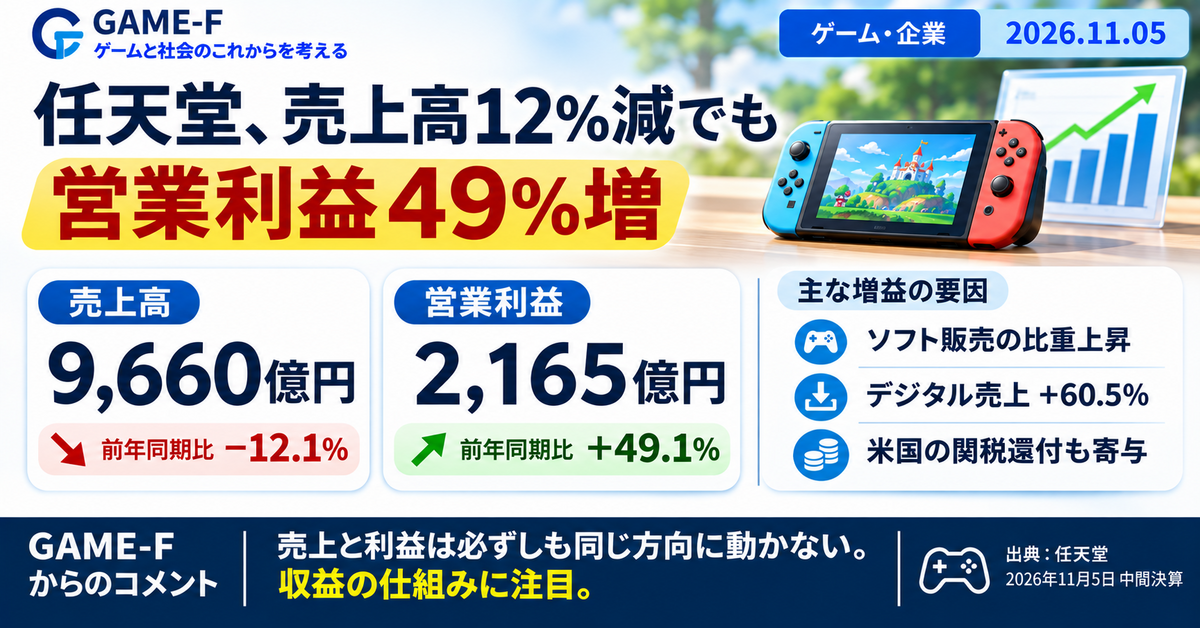
On November 5, 2026, Nintendo announced its financial results for the first half of the fiscal year ending March 2027, covering April through September 2026. Net sales declined 12.1% year-on-year to ¥966.0 billion, while operating profit increased 49.1% to ¥216.5 billion.
Why did Nintendo's profits rise so sharply despite lower revenue?
One important factor was a change in the balance between hardware and software sales. Sales of Nintendo Switch 2 consoles declined compared with the same period of the previous year, while software sales increased. Software generally offers higher profit margins than gaming hardware, so a greater contribution from software helped improve profitability.Digital sales, including downloadable games and other digital content and services, reached ¥249.6 billion, an increase of 60.5% year-on-year.Nintendo's business beyond video games also expanded. Revenue from intellectual property (IP)-related activities, including film and licensing businesses, increased 87.9% to ¥62.7 billion, supported in part by revenue associated with The Super Mario Galaxy Movie.
Another important factor was a refund of previously paid U.S. tariffs, which reduced costs and contributed to the increase in operating profit. Because this was a non-recurring factor, the improvement in profit should not be attributed solely to stronger underlying business performance.
These results demonstrate that a gaming company's financial performance depends not only on the number of consoles sold but also on software sales, digital distribution, intellectual property, and other sources of revenue.
Comment from GAME-F
Revenue and profit do not necessarily move in the same direction. Nintendo's latest financial results provide a clear example.
In recent years, gaming companies have developed increasingly diverse revenue streams, including downloadable software, additional content, subscription services, films, and character licensing.
At the same time, understanding how gaming companies generate revenue also requires attention to what players are paying for and how these business models operate.
When evaluating the growth of the gaming industry, it is important to consider not only the amount of revenue or profit generated but also the mechanisms through which that revenue is earned.
References
Nintendo Co., Ltd. Consolidated Financial Results for the Six Months Ended September 30, 2026. November 5, 2026.
Nintendo Co., Ltd. Financial Results Explanatory Material: First Half of Fiscal Year Ending March 2027. November 5, 2026.
4Gamer.net. Nintendo Announces Financial Results for the First Half of Fiscal Year Ending March 2027. November 5, 2026.
https://www.4gamer.net/games/945/G094545/20261105034/


Latest Fact Blog
-
Business2026.11.20GTA 6 Generates Approximately $6 Billion on Its First Day—Gaming Industry Growth and Age Ratings
-
Society & Policy2026.11.10Japan Proposes Age-Based Guidance for Children's Social Media Use—From Parental Control to Growing Independence
-
Business2026.11.09Capcom's Sales Rise 49%: The Strategy Behind Long-Selling Games
Category
Archive
- 2026-11 (4)
- 2026-10 (6)
- 2026-9 (12)
- 2026-8 (11)
- 2026-7 (5)
- 2026-6 (3)
- 2026-5 (2)
- 2026-4 (2)
- 2026-3 (3)
- 2026-2 (1)
- 2026-1 (2)
- 2025-12 (1)
- 2025-10 (1)
- 2025-9 (3)
- 2025-7 (2)
- 2025-6 (1)
- 2025-3 (1)
- 2024-11 (1)
- 2024-9 (1)
- 2024-8 (2)
- 2024-4 (1)
- 2024-3 (1)
- 2023-8 (1)
- 2023-7 (1)
- 2022-11 (1)
- 2022-9 (1)
- 2022-7 (1)
- 2022-6 (1)
- 2022-4 (1)
- 2022-1 (1)